How to Save 40% on Holiday Lighting Costs While Creating a Stunning Seasonal Display in 2026
Ads
Transform your holiday display while cutting lighting costs by 40% through strategic LED upgrades, smart shopping timing, energy-efficient practices, and creative design that maximizes visual impact without breaking the bank.
The holiday season brings joy, celebration, and often a significant increase in electricity bills. If you have ever stared at your December utility bill wondering how a few strings of lights could cost so much, you are not alone. The good news is that you can have a breathtaking seasonal display that makes your neighbors pause in admiration while keeping more money in your pocket. This guide will show you exactly how to save 40% on holiday lighting costs while creating a stunning seasonal display in 2026, combining practical money-saving strategies with creative design approaches that work for any budget.
Understanding the True Cost of Holiday Lighting
Before you can start saving, it helps to understand exactly where your money goes when you decorate for the holidays. Most households still use traditional incandescent bulbs for their seasonal displays, and these older-style lights consume significantly more electricity than modern alternatives. A single strand of 100 incandescent mini lights can draw around 40 watts of power, which adds up quickly when you are decorating the entire yard, roofline, and interior of your home.
The average American household spends between $50 and $200 on holiday lighting electricity alone, depending on how extensive their display is and how long they keep the lights running each day. This figure does not even include the cost of purchasing new lights or replacing burned-out bulbs throughout the season. When you factor in both the operational costs and the initial investment in lighting equipment, the total expense can become substantial.
Breaking Down Your Lighting Expenses
- Operational costs: Electricity consumption while lights are in use
- Initial investment: Purchasing lights, extension cords, timers, and accessories
- Maintenance costs: Replacing burned-out bulbs and damaged strands
- Replacement costs: Upgrading outdated lighting technology
Understanding these four cost categories gives you a clear roadmap for where to focus your savings efforts. Each category offers opportunities to reduce expenses without sacrificing the beauty of your display. The key is approaching your holiday lighting strategy as a comprehensive system rather than a collection of individual purchases.
LED Technology: Your Biggest Savings Ally
Switching to LED holiday lights represents the single most impactful change you can make to reduce your lighting costs. LED bulbs use approximately 75% less energy than traditional incandescent bulbs, which translates directly into lower electricity bills. But the savings do not stop there. LED bulbs also last up to 25 times longer than incandescent options, meaning you will spend significantly less on replacements over the years.
When you make the switch to LED, the math becomes compelling very quickly. If you currently spend $100 on electricity for your holiday lights, switching to LEDs would reduce that cost to around $25. Over a five-year period, that single change could save you $375 or more, depending on how extensive your display is and how long you run your lights each season.
Choosing the Right LED Products
- Look for the ENERGY STAR label: Certified products meet strict efficiency and quality standards
- Consider color temperature: Warm white LEDs create a classic holiday glow, while cool white offers a modern look
- Check the light-to-string ratio: More lights per strand means fuller displays with fewer strings to manage
- Verify outdoor ratings: Ensure LEDs are rated for outdoor use if you are decorating outside
Many people hesitate to switch to LEDs because they perceive the upfront cost as higher. While it is true that LED strands typically cost more initially than incandescent options, the long-term savings far outweigh the initial investment. Additionally, LED lights produce less heat, making them safer for use around dry greenery and reducing fire risks during the dry winter months.
Smart Planning: Design Strategies That Cut Costs
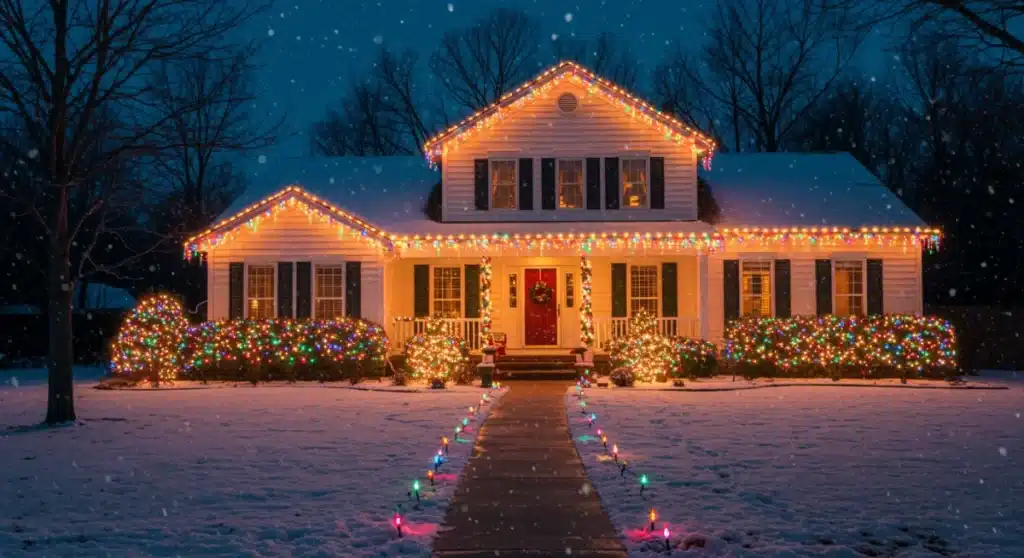
One of the most overlooked aspects of saving money on holiday lighting is the design phase. A well-planned display uses fewer lights to create more impact, focusing illumination on key architectural features and focal points rather than attempting to light every surface equally. This approach not only reduces your material costs but also lowers your electricity consumption.
Start by walking around your property during daylight hours and identifying the elements that would benefit most from illumination. The roofline, front entryway, prominent trees, and architectural details typically offer the best return on your lighting investment. By concentrating your lights in these strategic locations, you create a polished, professional appearance without the expense of lighting every bush and fence post.
High-Impact Design Principles
- Layer your lighting: Use a combination of ambient, task, and accent lighting for depth
- Highlight vertical spaces: Rooflines and tall trees create drama with fewer lights than ground-level displays
- Create focal points: Direct attention to entrance areas with concentrated illumination
- Use reflective surfaces: Position lights near snow, white fences, or reflective ornaments to amplify their effect
Consider also that a more restrained display often looks more elegant than an overdone approach. The most memorable holiday displays tend to feature thoughtful design rather than sheer quantity of lights. When you plan your layout with cost-efficiency in mind, you naturally create displays that feel curated and sophisticated rather than chaotic or overwhelming.
Timing and Shopping: When to Buy for Maximum Savings
The timing of your purchases can significantly impact how much you spend on holiday lighting supplies. Like most retail products, holiday lights follow seasonal pricing patterns that smart shoppers can leverage to their advantage. Understanding these patterns allows you to stock up on quality products at a fraction of their peak-season prices.
Post-holiday sales in January offer the deepest discounts, often reaching 70% or more off original prices. This is the ideal time to stock up on lights for the following year. However, you need to be selective and check that the lights you are purchasing still work properly, as damaged or defective items are common in clearance bins. Testing lights before purchasing or buying from retailers with generous return policies protects you from ending up with non-functional merchandise.
Strategic Shopping Calendar
- January (after holidays): Deep clearance sales, up to 70% off
- February through October: Moderate discounts on previous seasons’ stock
- Early November: Pre-holiday sales events and door busters
- Black Friday and Cyber Monday: Significant discounts on premium LED options
Another effective strategy involves shopping at discount retailers and warehouse stores during the off-season. These stores typically stock holiday lighting supplies months before the holiday season, often at prices lower than specialty retailers. By planning ahead and purchasing throughout the year rather than waiting until December, you can build a quality lighting collection without straining your budget.
Energy-Efficient Practices That Don’t Dim the Magic
Even with LED lights and smart design, how you use your holiday lighting matters significantly for your bottom line. Simple behavioral changes and practical accessories can reduce your electricity consumption without diminishing the beauty of your display. The key is finding the balance between creating that magical holiday atmosphere and being mindful of energy usage.
Timer controls represent one of the easiest ways to reduce lighting costs. Most people are not home during daylight hours, and many families turn in well before midnight, yet lights often stay on for much longer than necessary. A simple timer that turns your lights on at dusk and off at a reasonable hour, such as 10 or 11 PM, can cut your operational costs by 30% or more without any reduction in visual impact.
Practical Energy-Saving Accessories
- Light timers: Automate on/off cycles to match your schedule
- Photocell sensors: Automatically activate lights at dusk
- Smart plugs: Control lights remotely through smartphone apps
- Voltage regulators: Protect lights from power surges and extend their lifespan
Another effective practice involves limiting the number of hours your lights operate each day. While it might seem counterintuitive, reducing your daily lighting hours from 12 to 8 can cut your electricity costs by one-third while still providing ample time for neighbors and family to enjoy your display. Many families find that evening hours between 5 PM and 10 PM provide the best balance between visibility and cost savings.
Creative Alternatives That Deliver Big Impact
Innovation in holiday lighting has produced numerous alternatives to traditional string lights that can create stunning effects at a fraction of the cost. These creative options work alongside or even replace conventional lights, allowing you to achieve dramatic displays while spending less money. The most successful holiday decorators often combine multiple lighting techniques to create layered, multidimensional displays.
Projection lights have become increasingly popular in recent years, offering a way to cover large areas with moving images and colors without the labor-intensive process of hanging hundreds of individual light strands. A single projection unit can transform an entire house facade or large yard area, and these devices typically use only a fraction of the electricity required by traditional lighting methods.
Innovative Lighting Options to Consider
- Laser light projectors: Cover large areas with thousands of small dots or patterns
- LED rope lights: Flexible, durable, and ideal for outlining architectural features
- Net lights: Perfect for covering bushes and hedges quickly and evenly
- Icicle lights: Create elegant roofline displays with minimal installation time
Do-it-yourself decorations also offer opportunities for creative lighting solutions. Items like mason jars filled with LED fairy lights, illuminated wreaths, and homemade light sculptures can add personality to your display while costing significantly less than purchasing additional light strands. These handcrafted elements often become conversation starters and give your display a unique character that sets it apart from standard holiday lighting.
Long-Term Strategies for Annual Savings
Building a sustainable holiday lighting system requires thinking beyond a single season. By implementing long-term strategies, you can create an ever-improving display that actually costs less money each year. This approach transforms holiday lighting from a recurring expense into an investment that pays dividends over time.
Quality matters enormously when selecting lights that will last for many seasons. Spending a bit more on durable, well-made LED lights from reputable manufacturers typically proves more economical than buying the cheapest available options. These premium products resist damage from weather, handle repeated installation and storage better, and maintain their brightness throughout their extended lifespan.
Building Your Lighting Collection
- Invest in quality: Higher-priced LEDs often last 10+ years with proper care
- Organize systematically: Proper storage extends product life and reduces replacement needs
- Maintain regularly: Check and test lights annually before installation
- Expand gradually: Add to your collection each year during sales rather than buying everything at once
Creating an organized storage system for your holiday lights protects your investment and makes setup faster and easier each year. Properly coiled lights stored in protective containers last significantly longer than those stuffed loosely into boxes. Taking a few extra minutes to organize your lights after the holidays pays off in reduced replacement costs and easier installation in subsequent years.
| Key Strategy | Savings Impact |
|---|---|
| Switch to LED Lights | Up to 75% reduction in electricity costs per season |
| Use Light Timers | 30-40% reduction in operational costs |
| Strategic Shopping Timing | 50-70% off lighting supplies purchased post-holiday |
| Smart Design Approach | Fewer lights needed for greater visual impact |
Frequently Asked Questions
Switching to LED holiday lights can save you up to 75% on electricity costs compared to traditional incandescent bulbs. For example, if you currently spend $100 on holiday lighting electricity, LEDs would reduce that to approximately $25. Over multiple seasons, these savings compound significantly, especially when combined with the extended lifespan of LED bulbs that can last 10-25 times longer than incandescent options.
The best time to buy holiday lights is during post-holiday sales in January, when discounts can reach 70% or more off original prices. Black Friday and Cyber Monday also offer significant savings on premium LED options. Shopping throughout the year at discount retailers and warehouse stores allows you to build your lighting collection gradually at reduced prices, rather than purchasing everything at peak season rates.
Yes, timer controls can reduce your holiday lighting costs by 30-40% or more. Most people do not need lights running all night long, yet traditional displays often stay on for 12 or more hours daily. Timers that automatically turn lights on at dusk and off at 10 or 11 PM provide ample viewing time while dramatically cutting electricity waste. Smart plugs offer additional flexibility by allowing remote control through smartphone apps.
Absolutely. Strategic design that focuses on key architectural features and focal points creates more impact with fewer lights than attempting to illuminate every surface. Highlighting rooflines, entrance areas, and prominent trees or shrubs produces a professional, polished appearance. Using reflective surfaces like snow or light-colored surfaces amplifies the effect of fewer lights, while projection devices can cover large areas with dramatic effects using minimal electricity.
Proper storage involves coiling lights loosely around your hand or a cardboard form, then placing them in protective containers or storage bags designed for this purpose. Avoid tightly wrapping lights, which can damage wires and cause bulbs to break. Store lights in a dry, temperature-controlled location to prevent moisture damage. Label containers by location or type for easier setup next season. Taking time to organize and protect your lights extends their lifespan significantly.
Conclusion
Creating a stunning holiday lighting display while saving 40% or more on costs is entirely achievable with the right approach. By transitioning to LED technology, planning your display strategically, shopping at the right times, implementing energy-saving practices, and investing in quality products that last, you can enjoy a breathtaking seasonal display that enhances your home’s curb appeal without straining your budget. The key is treating your holiday lighting as a year-round investment rather than a seasonal expense, making thoughtful decisions that compound savings over time. Start implementing these strategies now, and by the 2026 holiday season, you will have mastered the art of beautiful, budget-friendly holiday lighting that your family can enjoy for years to come.